
World First Aid Day 2026: Does Your Business Have a Trained First Aider?

World First Aid Day falls on 12 September 2026, and it is a good moment to ask a simple question about your own workplace. If a member of staff or a customer collapsed today, is there someone on site trained to help while the ambulance is on its way? For a lot of Cumbrian businesses the honest answer is not certain. This guide shows you how to check whether you have a trained first aider, and how many you really need.
What World First Aid Day is
World First Aid Day is marked every year on the second Saturday of September, which in 2026 is 12 September. It exists to remind people how much difference basic first aid makes in the minutes before professional help arrives. For an employer, it is a natural prompt to look at your own arrangements rather than assume they are fine.
How to tell if you have enough first aiders
The right number is not a fixed figure. It comes from a short first aid needs assessment, which looks at your particular workplace. The things that push the number up are worth thinking through:
- How many people are on site, including busy periods.
- How risky the work is: a quiet office is different from a kitchen, a workshop or a farm.
- The layout: a spread-out site or several floors may need cover in more than one place.
- Shifts and cover: someone qualified needs to be there whenever people are working, including holidays and sickness.
- Lone workers and the public: both raise what you should have in place.
What “trained” actually means
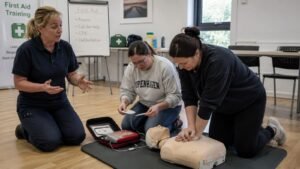
There are two main workplace qualifications. Emergency First Aid at Work is a one day course, suited to lower-risk workplaces. First Aid at Work is a three day course for higher-risk settings and larger teams. Both certificates are valid for three years, and a short annual refresher is recommended in between to keep skills sharp. If a certificate has lapsed, that person no longer counts as a trained first aider.
Every employer must make sure there is adequate and appropriate first aid provision, so that anyone taken ill or injured at work can be helped straight away. That means the right equipment, the right facilities, and enough trained people.
Your World First Aid Day check
Run through this today
- Do you have at least one trained first aider on site whenever people are working?
- Are their certificates still in date, and is a refresher booked before they lapse?
- Is there cover for holidays, sickness and different shifts?
- Does the level of training match the real risks of the work?
- Is the first aid kit stocked, and does everyone know where it is?
Your questions answered
How many first aiders does my business need?
It depends on your numbers, your level of risk and your layout. A short first aid needs assessment gives you the answer. Lower-risk workplaces need fewer, higher-risk ones need more, and you always need cover for absence.
How long does a first aid certificate last?
Three years. A short annual refresher in between is recommended so skills and confidence do not fade before the certificate runs out.
What is the difference between EFAW and FAW?
Emergency First Aid at Work is a one day course for lower-risk workplaces. First Aid at Work is a three day course covering a wider range of injuries and illnesses, for higher-risk settings.
Sources
- Health and Safety Executive, First aid at work guidance (hse.gov.uk).
- Health and Safety Executive, Health and safety statistics, non-fatal injuries, Labour Force Survey (hse.gov.uk).
Get your team first aid trained in Penrith
Cumbria Fire & Safety Training runs Emergency First Aid at Work and First Aid at Work courses at our Penrith centre. October dates are available now, so book your team in before the winter.
Call 01768 807 258